Amphora Shaped Jar
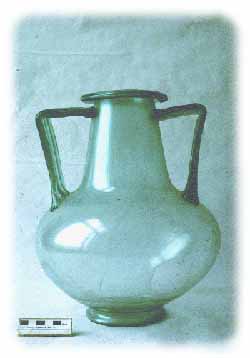
Roman, circa 100 - 150AD
Deal Archaeological Collection
This artefact was discovered during work at Walmer Lodge in 1901. At a site, near the shore, workmen found "at a depth not exceeding 18 inches" [c.450mm] "a large earthenware vessel" which proved to be a large globular amphora which had had its neck broken off in antiquity.
This is similar to the one on display in the Ground Floor Gallery in Dover Museum.
Inside this were contained:
"a bottle-shaped vessel of light red clay [...] a Patera [dish] of Samian ware [and] a two-handled vase of of light green glass [...]This vessel is of globular form, with wide neck, increasing in size as it meets the globe. The handles are wide and massive, and are formed of three convex moulded bands. The glass, with the exception of the rim, handles and base, is very thin."
This interment was the second discovered at the site and further excavation revealed several more. The author of the afore-quoted article on the discovery, C.H. Woodruff, brother of another noted antiquarian, Reverend C.E. Woodruff, also commented on the fact that traces of decaying vegetable matter were found on some of the artefacts. Woodruff considered this to be evidence that this "swampy ground had been chosen as the place of sepulture."
Dimensions
- Height : 295mm
- Diameter : 240mm
C. H. Woodruff : 'Romano-British internments at Lower Walmer' in Archaeologia Cantiana Vol. XXV (1902) pp1-10.
Photograph credit : B. Barnes
Dover Museum
Market Square, Dover CT16 1PH
Opening hours
April-September:
Monday-Saturday 9.30am-5pm
Sunday 10am-3pm
October-March:
Monday-Saturday 9.30am-5pm
Closed Christmas Day, Boxing Day and
New Year's Day
Roman Painted House
New Street, Dover CT17 9AJ
Opening hours 2026
Open from Friday 3 April - Saturday 31 October
School holidays: Thursday-Sunday 10am-4pm
Term-time: Saturday only 10am-4pm
Heritage Open Days: Daily 10am-4pm
Please see website or social media for re-opening updates.